
6 Ways to Invest in OpenAI (ChatGPT)

OpenAI is racing toward the public markets.
In October 2025, just weeks after being valued at $500 billion and becoming the world's most valuable company, the lab announced a major restructuring that cleared the path for an initial public offering.
Shortly thereafter, news broke that it was targeting an IPO in the second half of 2026, with more recent coverage specifying it's most likely to come in the fourth quarter. The public offering is expected to value the company at more than $1 trillion.
Until then, OpenAI needs more funding.
In December, the lab began raising a new funding round targeting $100 billion at an $830 billion valuation. The round was pushed to $110 billion and an $840 billion valuation by the time it closed in February.*
*The round included $30 billion from SoftBank, $30 billion from NVIDIA, and $50 billion from Amazon. Additional investors are expected to join the round in the coming weeks.
Investor interest has not slowed, and the company's growth helps explain why.
ChatGPT has more than 900 million weekly users, and the lab crossed $20 billion in annualized revenue in December 2025, both roughly triple from a year ago.
If you're wondering how you can get invested, keep reading.
How it got here
In November 2022, OpenAI released ChatGPT, an AI chatbot based on a large language model (LLM) that generates detailed and human-like responses to user queries.
ChatGPT went viral, reaching 100 million users in just two months, the fastest product to ever reach the milestone (at that time).
OpenAI's launch of ChatGPT — and its associated API — has ushered in a new wave of development in artificial intelligence all over the world.
Regardless of where AI goes from here, it's hard to imagine OpenAI won't play a prominent role, which is probably why you're wondering how to invest in it.
Here's how.
How to invest in OpenAI
OpenAI is not a public company, which means there is no OpenAI stock symbol, and it cannot be bought in your typical brokerage.
But you don't need to wait for its IPO to gain exposure to OpenAI and ChatGPT.
Here are six ways to invest in OpenAI stock today, while it's still a private company.
1. Buy shares from current shareholders
Hiive and Forge are secondary marketplaces where accredited investors can buy shares of private, VC-backed startups.
Accreditation requirements
To qualify as an accredited investor, you must meet one of the following criteria:
- Have an annual income of $200,000 individually or $300,000 jointly.
- Have a net worth that exceeds $1,000,000, excluding your primary residence.
- Be a qualifying financial professional with a Series 7, 65, or 82 license.
Both platforms connect existing shareholders — typically employees, venture capital firms, or angel investors — with accredited investors looking to buy shares in private companies. Once a buyer and seller agree on a price, the platform facilitates the transaction.
Thousands of private companies have shares available on these marketplaces, including Anthropic, SpaceX, and Cerebras Systems. Availability and pricing can vary between platforms, so many investors monitor multiple marketplaces when looking for shares.
You can check what's currently available for OpenAI on each of these platforms by registering below:
|
Hiive
Check current availability for OpenAI investment opportunities.
Register for Hiive |
Forge
Compare listings and see whether OpenAI shares are available.
Register for Forge |
Disclosure: These are affiliate links. We may receive compensation if you take action through them.
2. Invest via the Fundrise Innovation Fund
The Fundrise Innovation Fund is a venture capital fund available to all investors that invests in private technology companies.
The fund's investment thesis is centered around a few themes: data infrastructure, real estate technology, machine learning, and artificial intelligence.
It currently owns stakes in 16 companies, including Anthropic, Databricks, Service Titan, Ramp, and OpenAI.
While OpenAI isn't listed publicly as one of the fund's holdings, it does show as a holding once you register and become an investor in the fund (see the image below from my investor account):
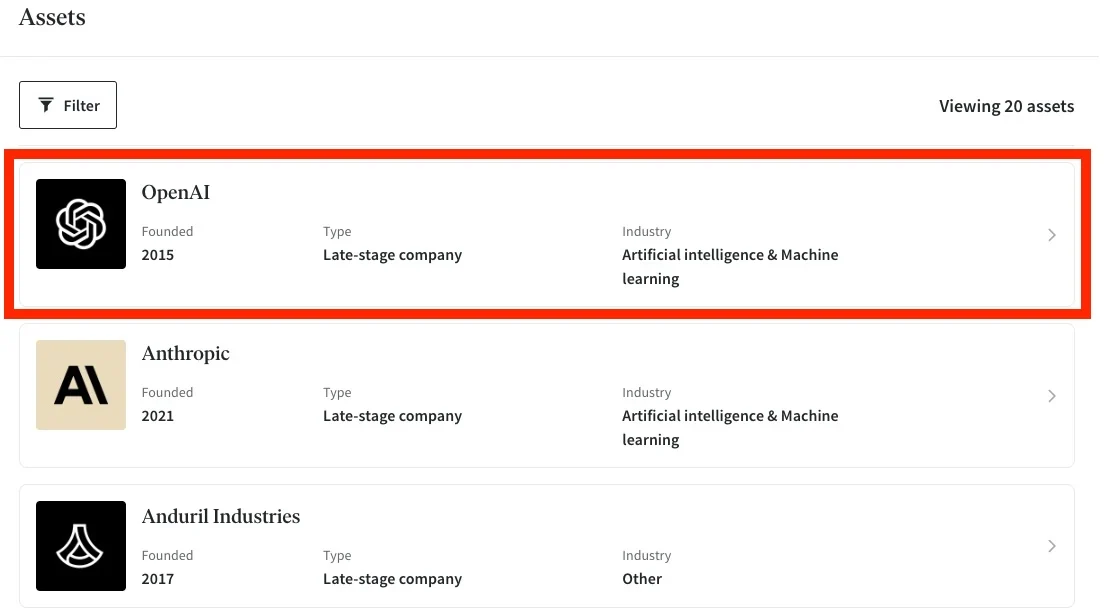
The fund has exposure to OpenAI through an SPV, which may prevent it from advertising the position to non-investors.
The Innovation Fund is open to all U.S. residents, has an annual management fee of 1.85%, and a minimum investment of just $10.
For more information about the fund, see my Fundrise Innovation Fund Review.
3. Invest via the ARK Venture Fund
The ARK Venture Fund is an actively managed fund that invests based on its theme of "disruptive innovation."
The fund invests in both public and private companies, though all of the top 10 holdings are private companies. As of the end of January, OpenAI made up 2.93% of the fund, its 9th largest position:
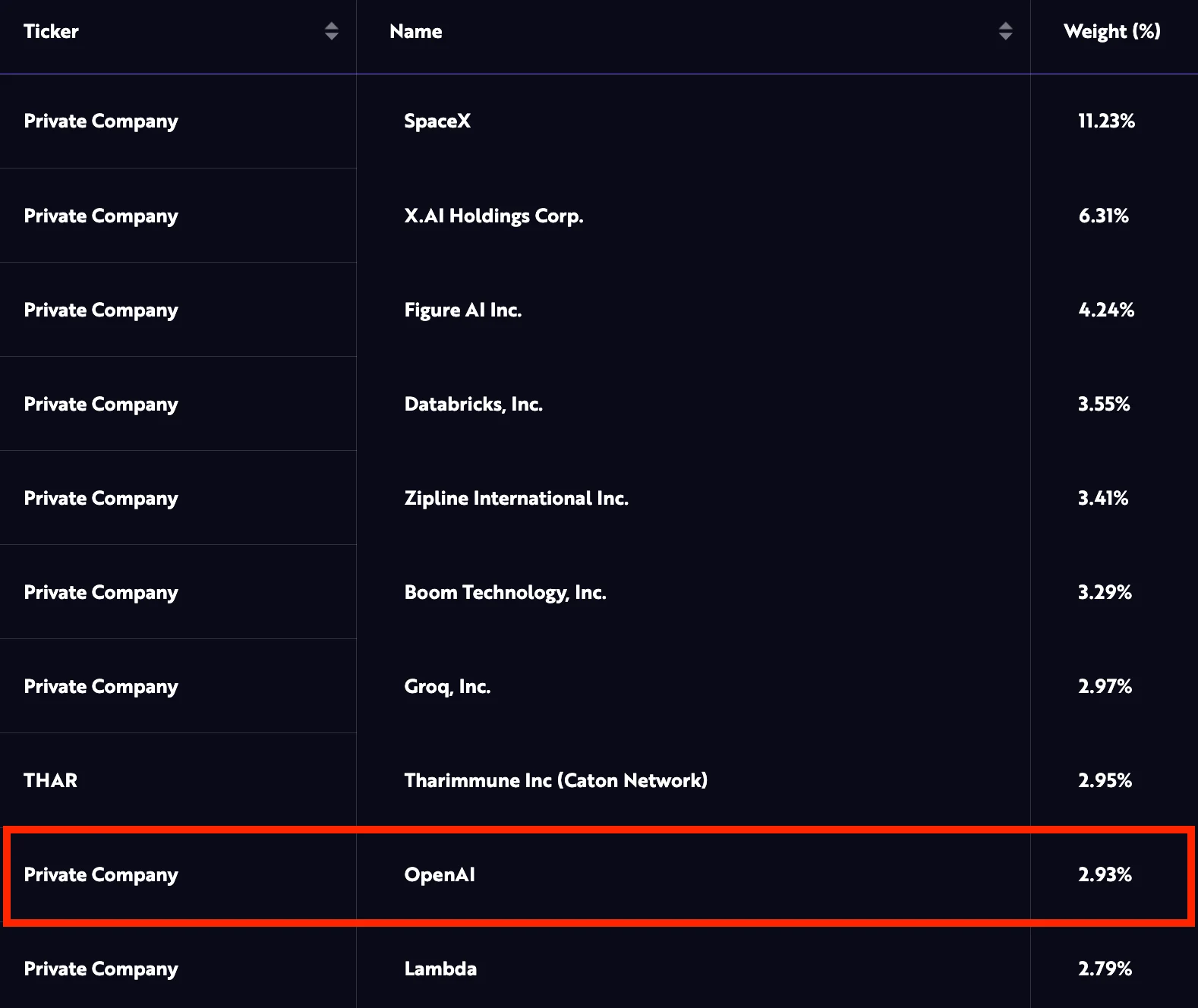
Other companies in the fund's top 10 include SpaceX, xAI, Figure AI, and Lambda Labs.
The fund is available to all investors and has a 2.90% annual management fee. You can learn more about the fund and how to invest in it via the ARK website.
4. Invest indirectly (via Microsoft or Nvidia)
OpenAI has strategic partnerships with Microsoft and Nvidia.
Here are more details on both and how an investment in either of these companies would give you indirect exposure to OpenAI.
Microsoft
Microsoft (MSFT) has invested in OpenAI on multiple occasions and has a unique relationship with the lab.
Here's the history:
- 2019: Microsoft made its first major investment in OpenAI, committing $1 billion.
- 2021: Microsoft quietly expanded the partnership with undisclosed additional investments and deeper integrations, including offering OpenAI's models through Azure OpenAI Service.
- 2023: Microsoft invested an additional $10 billion in a deal that included funding OpenAI's compute needs on Azure, securing a 49% share of OpenAI's profits up to an undisclosed cap, and having no control over OpenAI's governance.
- 2025: OpenAI's corporate restructuring gave Microsoft a 27% stake (plus bonuses).
Until recently, Microsoft's equity stake in OpenAI was not clearly defined, even in its SEC filings.
That changed in October 2025, when OpenAI restructured and moved away from its nonprofit roots (more on this below).
As part of the restructuring, Microsoft received a 27% stake in the newly formed for-profit entity (OpenAI Group PBC), worth $135 billion. At an $840 billion valuation, its stake is now worth over $225 billion.*
*According to OpenAI, the February 2026 round changed nothing about its partnership with Microsoft.
In addition to its equity stake, Microsoft will continue receiving roughly 20% of OpenAI's revenue and retain certain rights to OpenAI's products and underlying AI models.
This will continue until an independent panel verifies that OpenAI has achieved artificial general intelligence (AGI).
Microsoft also received a $250 billion cloud computing contract with OpenAI, though it agreed to give up its right of first refusal as the company's primary compute provider.
It also retained its right to embed OpenAI's models into its own products and services. Here's how it's currently incorporating the lab's technology:
- Copilot: Microsoft integrated OpenAI's GPT models into Copilot tools across Word, Excel, Outlook, PowerPoint, and GitHub, transforming all of Microsoft's most popular apps into AI-enabled platforms.
- Azure OpenAI Service: Microsoft offers commercial access to OpenAI's models through Azure, charging businesses for cloud-based API usage.
- Bing and Edge: Microsoft's search engines are also powered by OpenAI's technology, which improves search results and answers user queries faster.
These product integrations have allowed Microsoft to charge premium prices for enhanced versions of its Office 365, GitHub, and Azure services, positioning itself as a real leader in personal and enterprise AI.
Altogether, Microsoft has invested $13.8 billion in OpenAI, meaning its stake has more than 15x'd in value and now represents almost 8% of its $2.9 trillion market capitalization.
Nvidia
While Microsoft has a long-standing relationship with OpenAI, perhaps the most practical way to get exposure to the lab's growth is through Nvidia (NVDA).
The two companies are tightly linked. OpenAI relies heavily on Nvidia's GPUs to train and run its models, while Nvidia benefits from being the hardware backbone of the leading AI lab. It's a natural pairing of best-in-class software and best-in-class hardware.
In September 2025, Nvidia invested $10 billion in OpenAI and committed to deploying up to $100 billion, in $10 billion increments, to support the lab's expansion.
But those plans shifted quickly. In February 2026, Nvidia invested another $30 billion in OpenAI, seemingly deepening its relationship with the startup.
However, just weeks after the funding was announced, Nvidia CEO Jensen Huang said the $30 billion investment would likely be its last, and that the previously announced $100 billion deal is probably "not in the cards."
The bulk of Nvidia's investments in OpenAI are being used to lease the chipmaker's GPUs, raising concerns over the circular nature of the deals.
Amazon
Amazon (AMZN) was the biggest contributor to OpenAI's February 2026 round, investing $50 billion in the lab.
Alongside the investment, OpenAI committed to increasing its existing multiyear, $38 billion compute contract with Amazon's AWS by over $100 billion. OpenAI also agreed to consume 2 gigawatts of capacity on Amazon's new Trainium AI chips.
5. Invest in other leading AI companies
There are other companies outside of Microsoft, Nvidia, and Amazon you may be interested in, including an Nvidia supplier.
Taiwan Semiconductor Manufacturing Company (TSMC)
TSMC (TSM) manufactures the advanced chips designed by companies like Nvidia, giving it a critical role as the world's leading producer of the semiconductors powering AI infrastructure.
As Nvidia attempts to double its GPU output, it may rely more and more heavily on TSMC.
More companies with AI exposure
Here are a few other tech companies with exposure to AI:
- Alphabet (GOOG, GOOGL): Google has invested heavily in AI for years and may be the biggest beneficiary of AI-powered search. Their Gemini (formerly Bard) chatbot is also one of the biggest competitors to ChatGPT, plus the Google Cloud Platform will likely be running a lot of AI applications in the future.
- Meta Platforms (META): Meta's artificial intelligence lab (Meta AI) was launched in 2013. Since that time, Meta has poured billions of dollars into developing generative AI, computer vision, and human speech processing technologies.
There are also other private companies you may be interested in, such as Figure AI, Anthropic, and Cerebras Systems.
6. Invest in exchange-traded funds
Instead of buying an individual stock, you may want to diversify across a broad range of companies focused on similar technology via an ETF:
- Roundhill Generative AI & Technology ETF (CHAT): This ETF invests in companies focused on generative AI, the same technology powering ChatGPT.
- ROBO Global Robotics & Automation ETF (ROBO): This fund buys companies from around the world that are focused on robotics and automation.
- First Trust Nasdaq Artificial Intelligence and Robotics ETF (ROBT): This is another global fund focusing on artificial intelligence and robotics companies.
- Global X Robotics & Artificial Intelligence ETF (BOTZ): This fund focuses on companies involved in the development and production of robots or AI.
- iShares Exponential Technologies ETF (XT): This iShares fund invests in disruptive information technology companies.
While none of these ETFs owns OpenAI, they will give you general exposure to the artificial intelligence industry.
Don't have a brokerage account?
If you don't have a brokerage account, check out our overview of the 7 best brokerage accounts in 2026. Spoiler: We like Public.
When will OpenAI IPO?
The only way for retail investors to buy shares of OpenAI directly is through a public offering, which now appears to be coming sooner than previously expected.
In September 2025, when asked about a potential IPO, CEO Sam Altman said, “I assume that someday we will be a public company… For now, we're certainly able to raise a lot of capital in private markets.”
Just one month later, during a livestream announcing the company's restructuring, Altman struck a different tone, saying a public offering was the most likely path forward given OpenAI's massive and growing capital needs.
Three days after that announcement, rumors surfaced that OpenAI was laying the groundwork for a potential $1 trillion IPO as soon as the second half of 2026.
Then, in January, reports emerged suggesting the lab was aiming for a public debut in the fourth quarter of this year.
The speed of that shift is telling.
What was once framed as a distant inevitability is now a near necessity. Access to public markets would give OpenAI a far more flexible funding base, allowing it to issue equity and debt at a scale that private markets may struggle to support.
The race to go public
Pressure is mounting for OpenAI to go public.
For starters, Anthropic has openly discussed a path toward an eventual public offering, raising the prospect that OpenAI's closest pure-play rival could reach public markets first.
Additionally, xAI is now discussing a potential merger with SpaceX, which is itself expected to become publicly traded in mid-2026.
This IPO pressure is running in tandem with typical competitive pressure, as rival AI firms like Anthropic, Google, xAI, and many others are all working to produce the highest-quality models.
OpenAI is also in an ongoing legal dispute with Elon Musk, one of the lab's original cofounders, who is seeking up to $134 billion in damages.
Taken together, IPO-bound rivals, intensifying competition, and growing legal and capital demands are accelerating OpenAI's push toward the public markets.
When it does go public, you'll need a brokerage account to buy stock. If you don't have a brokerage account, we recommend Public.
Corporate restructuring
In October 2025, OpenAI completed a corporate restructuring in a move that freed itself from its nonprofit roots.
The for-profit segment, which was the part valued at $500 billion, was converted into a public benefit corporation (PBC) called OpenAI Group PBC.
The original nonprofit entity, renamed the OpenAI Foundation, retained legal control and received a 26% stake of the PBC worth $130 billion.*
*Under the new structure at the time, Microsoft owned 27%, the OpenAI Foundation owned 26%, and the remaining 47% was held by investors and employees.
The restructuring removed major constraints on OpenAI's ability to raise capital and also paved the way for its future IPO.
Infrastructure projects
In September 2025, OpenAI struck a deal with Nvidia that will enable it to deploy 10 gigawatts of data center capacity powered by 4–5 million of the chipmaker's GPUs.
The announcement was the latest in a string of similar deals. In total, OpenAI had announced commitments to build 30 gigawatts of infrastructure, an outlay of at least $1.4 trillion based on current estimates.*
*Nvidia CEO Jensen Huang has estimated that building one gigawatt of data center capacity costs between $50 and $60 billion (of which roughly $35 billion goes toward Nvidia chips and systems).
However, in mid-February 2026, the lab lowered its spending expectations to $600 billion.
For reference, OpenAI generated $13.1 billion in revenue and lost $8 billion in 2025.
How much is OpenAI worth?
In February 2026, OpenAI raised $110 billion at a post-money valuation of $840 billion, up from the $500 billion valuation it during its October 2025 secondary share sale.
The February round pushed its total funding to over $171 billion since being founded in 2019.
Here's a look at how its valuation has changed over time:
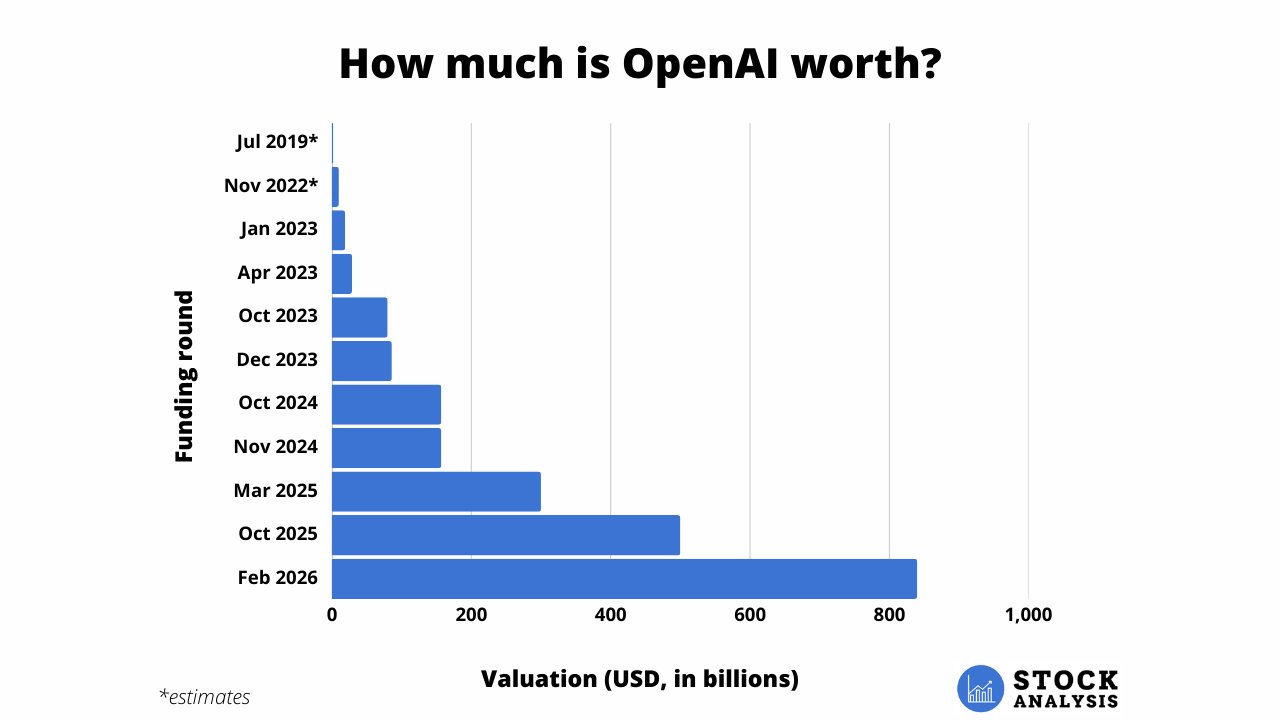
Its $840 billion valuation makes it the second most valuable private company in the world behind SpaceX.
Frequently asked questions
Below are a few more questions often asked about investing in OpenAI.
Who owns OpenAI stock?
OpenAI began with an initial seed funding of $50 million from Elon Musk, who was a co-founder of the company before leaving in 2018.
The lab has raised a total of $171.9 billion from 34 investors over 11 funding rounds.
Most recently, Amazon, Nvidia, and SoftBank invested $110 billion at an $840 billion valuation in February 2026.
Does Elon Musk own a stake in OpenAI?
While Elon Musk was a co-founder and originally invested $50 million to start the lab, he sold his stake to Microsoft and left the company in 2018.
Musk had reportedly committed $1 billion in support before pulling out over disagreements about the speed of OpenAI's advancements.
Since then, he has repeatedly criticized the lab for not placing enough emphasis on safe AI development and has recently filed a lawsuit claiming CEO Sam Altman breached their contract by abandoning their original mission to focus on profits.
In April 2023, Musk incorporated xAI, a rival AI firm. xAI was acquired by SpaceX in February 2026 in a deal that valued the combined entity at $1.25 trillion.
Any views expressed here do not necessarily reflect the views of Hiive Markets Limited (“Hiive”) or any of its affiliates. Stock Analysis is not a broker dealer or investment adviser. This communication is for informational purposes only, and is not a recommendation, solicitation, or research report relating to any investment strategy, security, or digital asset. All investment involves risk, including the loss of principal and past performance does not guarantee future results. There is no guarantee that any statements or opinions provided herein will prove to be correct. Stock Analysis may be compensated for user activity resulting from readers clicking on Hiive affiliate links. Hiive is a registered broker-dealer and member of FINRA / SIPC. Find Hiive on BrokerCheck.

.png)