
9 Best Alternative Investment Platforms

Your stock-bond portfolio might be outdated.
Many investors are now adding alternative investments to build more diversified portfolios.
In addition to providing returns less correlated with public markets, alternative investments may generate higher returns and serve as hedges against inflation.
For these reasons, alternatives are becoming an increasingly popular asset class, especially among institutional investors. For instance, BlackRock's portfolio advisory business has shifted from using the traditional 60-40 stock-bond portfolio to an allocation of 50% stocks, 30% bonds, and 20% alternatives.
And thanks to a number of alternative investment platforms, these assets are no longer limited to the top 1%. Everyday investors can now add private market investments to their portfolios.
Here's my list of the 9 best alternative investment platforms.
What is an alternative investment platform?
Before getting into the list, we first need to cover what constitutes an alternative investment.
Traditional assets are stocks, bonds, and cash, so any asset outside of those three is considered an alternative asset. This includes real estate, art, collectibles, cryptocurrency, private credit, private equity, and more.
However, since most alternative assets are not available on traditional investing platforms (such as a brokerage account), you need an account on an alternative investment platform to access them.
Here are some of the most popular ones you should know about.
Are you an accredited or retail investor?
Some of these platforms are only available to accredited investors. You qualify as an accredited investor if you meet one of the following criteria:
- You have an annual income of $200,000 individually or $300,000 jointly
- Your net worth exceeds $1,000,000 (excluding your primary residence)
- You are a qualifying financial professional
If you don't meet one of these criteria, you're a retail investor (don't worry, there are great options for you, too).
A quick look at the best platforms
- Best overall: Fundrise
- Best for private credit: Percent
- Best for pre-IPO investments: Hiive, Forge
- Best for many alternative investments: Willow Wealth
- Best for commercial real estate projects: EquityMultiple
- Best for art investing: Masterworks
- Best for farmland: AcreTrader
Keep reading for detailed breakdowns of each platform listed above.
Disclosure: These are affiliate links. We may receive compensation if you take action through them.
Disclaimer: Ratings are my opinion. Actual results may vary, and past performance does not guarantee future results. All investors should do their own due diligence.
1. Fundrise: best overall
- Our rating:
- Asset(s): Real estate, venture capital, private credit
- Accreditation requirement: Any investor
Fundrise was one of the first platforms to offer crowdfunded real estate investing, enabling anyone to invest in real estate with as little as $10.
Today, Fundrise manages $2.87 billion in equity on behalf of 385,000+ investors.
Furthermore, while real estate continues to be its most popular asset class — its real estate portfolio spans $7+ billion in assets — Fundrise has expanded into venture capital and private credit.
On the venture capital side, its Fundrise Innovation Fund (VCX) is a publicly-traded, closed-end venture capital fund that owns stakes in private, high-growth technology companies. Some of its largest holdings are in Anthropic, Databricks, OpenAI, and Anduril. You can read more about the fund here.
For private credit, Fundrise launched the Income Fund. The fund provides gap financing for ground-up multifamily housing development in the Sunbelt. It has delivered an 8.2% annualized return since its inception in 2022.
Altogether, Fundrise's size, track record, brand, and private market offerings make it one of the best options for diversifying a portfolio outside of stocks and bonds.
Primary benefit: Retail investors can invest in real estate, venture capital, and private credit from a single provider.
2. Percent: best for private credit
- Our rating:
- Asset(s): Private credit
- Accreditation requirement: Accredited only
While Fundrise has a private credit fund, Percent gives you more direct access to the $3.17 trillion private credit market.
Mid-sized private companies (those with annual revenue between $10 million and $1 billion) are too big for traditional banks but can't issue bonds on the public markets, so they must turn to the private credit markets for financing.
Since the money is harder to come by, the terms tend to be very favorable for lenders. Private credit deals typically entail:
- Higher yields
- Shorter durations
- Secured debt (loans are backed by assets)
Not to mention, private credit is largely uncorrelated with public markets, making it an excellent tool for diversification.
Here's how it stacks up against other asset classes:
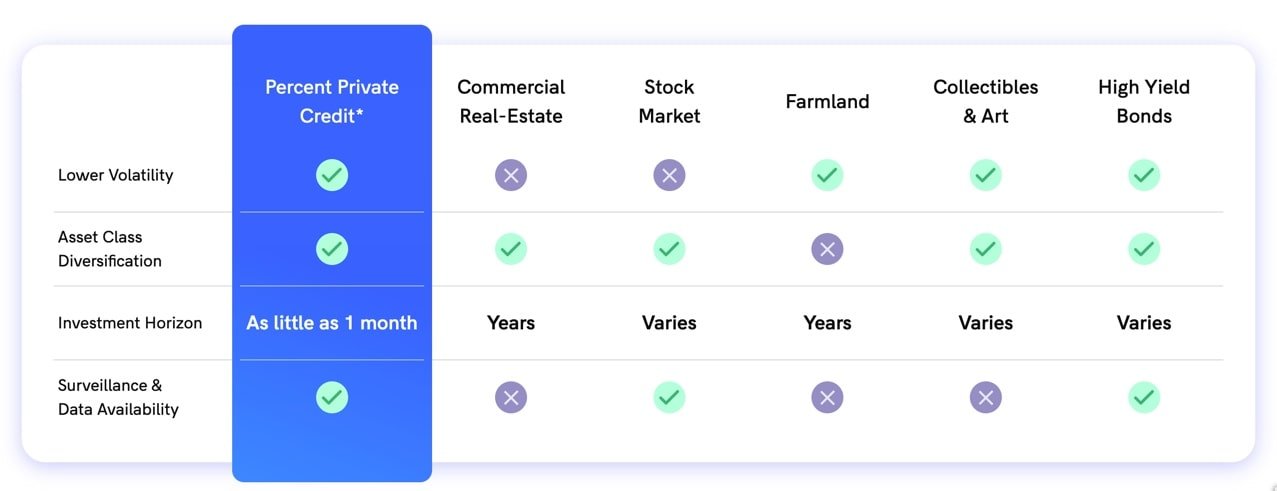
Source: Percent
For these reasons, private credit is extremely popular among institutions and yield-focused investors.
In my opinion, Percent is the best platform for accessing it.
Since its launch, investors have invested $1.95 billion across 1,048 deals on the platform. Matured deals have averaged a 14.76% annual coupon rate and a 3.7% default rate.
Given these figures, it's not hard to see why 89% of investors on Percent choose to re-invest in a second deal.
Plus, Percent is offering a welcome bonus of up to $500 when new investors make their first investment.
Primary benefit: Largest inventory of private credit deals.
Disclosure: This is an affiliate link. We may receive compensation if you take action through it.
Looking for more information? See my full Percent Review.
3. Hiive, Forge: best for pre-IPO investments
- Our rating:
- Asset(s): Private companies
- Accreditation requirement: Accredited only
Hiive and Forge are the two best platforms for investing in pre-IPO companies.
Each platform allows accredited investors to buy shares of private, VC-backed startups. There are thousands of private companies listed on each platform, including Anthropic, Databricks, and Anduril.
Hiive and Forge function similarly to traditional stock exchanges: Sellers (typically employees) create listings by setting a price and number of shares available, then buyers can accept a seller's asking price or place bids on the shares. Once the two parties agree on a price, the platforms facilitate the transaction.
Here are the major differences between Hiive and Forge:
| Hiive | Forge | |
| Number of companies | 3,000+ | 5,000+ |
| Monthly transaction volume | $250+ million | $80+ million |
| Minimum investments | • $25,000 on direct purchases • $5,000 on funds |
• $100,000 on direct purchases • $5,000 on funds |
Because pricing and availability vary by platform, I recommend creating accounts on both Hiive and Forge to make sure you're getting the best price.
Primary benefit: Buy shares of private, VC-backed companies.
| Check out Hiive | Check out Forge |
Disclosure: These are affiliate links. We may receive compensation if you take action through them.
4. Willow Wealth: best for many alternative investments
- Our rating:
- Asset(s): Real estate, art, private credit, cryptocurrencies, VC, private equity, notes, infrastructure, and a multi-asset class fund
- Accreditation requirement: Primarily accredited
Willow Wealth (formerly Yieldstreet) offers ten alternative assets all under a single login, making it one of the premier platforms for private market investing.
Since 2015, a diversified private markets portfolio — consisting of private equity, credit, and real estate — has outpaced the traditional 60/40 stock-bond mix by several percentage points per year:

Source: Willow Wealth
But the bigger story is risk. That same portfolio delivered a 2.2 efficiency ratio, more than double the 0.9 of the 60/40 portfolio — meaning investors got higher returns with significantly less volatility.
This blend of performance and risk reduction is exactly why alternatives deserve a place in the modern portfolio. And if diversification into alternatives is your goal, it's hard to find a better platform than Willow Wealth.
Willow Wealth allows you to invest in individual deals if you want, but most investors use one of its Managed Portfolios which spread your investment across a variety of private market deals.
There are three Managed Portfolios (Income, Balanced, and Growth) you can choose from, depending on your goals.
Additionally, Willow Wealth offers the Alternative Income Fund, an income-focused fund available to all (not just accredited) investors.
Given all of these options, it's no surprise investors have invested more than $6 billion on Willow Wealth since 2015.
Primary benefit: More private market asset classes than any other platform.
Disclosure: This is an affiliate link. We may receive compensation if you take action through it.
5. EquityMultiple: best for commercial real estate projects
- Our rating:
- Asset(s): Commercial real estate projects
- Accreditation requirement: Accredited only
EquityMultiple is a crowdfunding real estate platform focused on commercial real estate, and is quickly growing in popularity thanks to a few unique offerings.
For example, the Ascent Income Fund targets stable income by taking senior debt positions, so every investment is backed by real assets. The historical distribution yield is 9.08% and the minimum investment is $5,000.
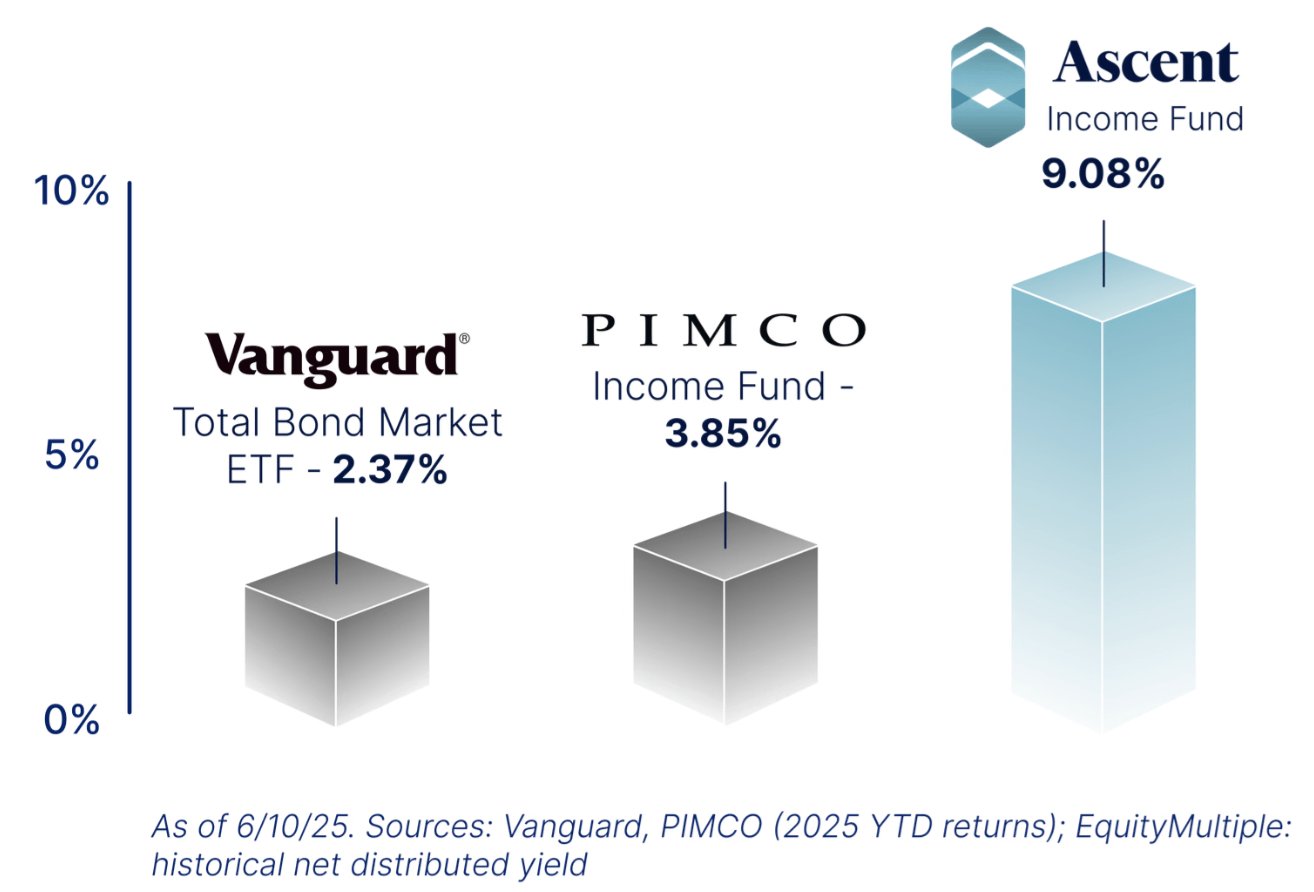
Source: EquityMultiple
In today's economic environment, you may be interested in short-term investments with high single-digit yields. To that end, EquityMultiple offers Alpine Notes.
Alpine Notes are a series of short-term notes that come in 3-, 6-, and 9-month terms with fixed APYs of 6%, 7%, and 7.35%, respectively. The capital raised through Alpine Notes is used as a line of credit for EquityMultiple's core real estate investments.
Primary benefit: Invest in commercial real estate via short-term notes, equity, and/or funds.
Disclosure: This is an affiliate link. We may receive compensation if you take action through it.
6. Masterworks: best for art investing
- Our rating:
- Asset(s): Fine art
- Accreditation requirement: Any investor
Masterworks is the leading platform for fractional art investing, with over $1.3 billion invested and 1+ million members.
The investment case for art comes down to two things: strong long-term appreciation (11.2% annually from 1995-2024) and near-zero correlation with stocks (0.08 vs. the S&P 500).
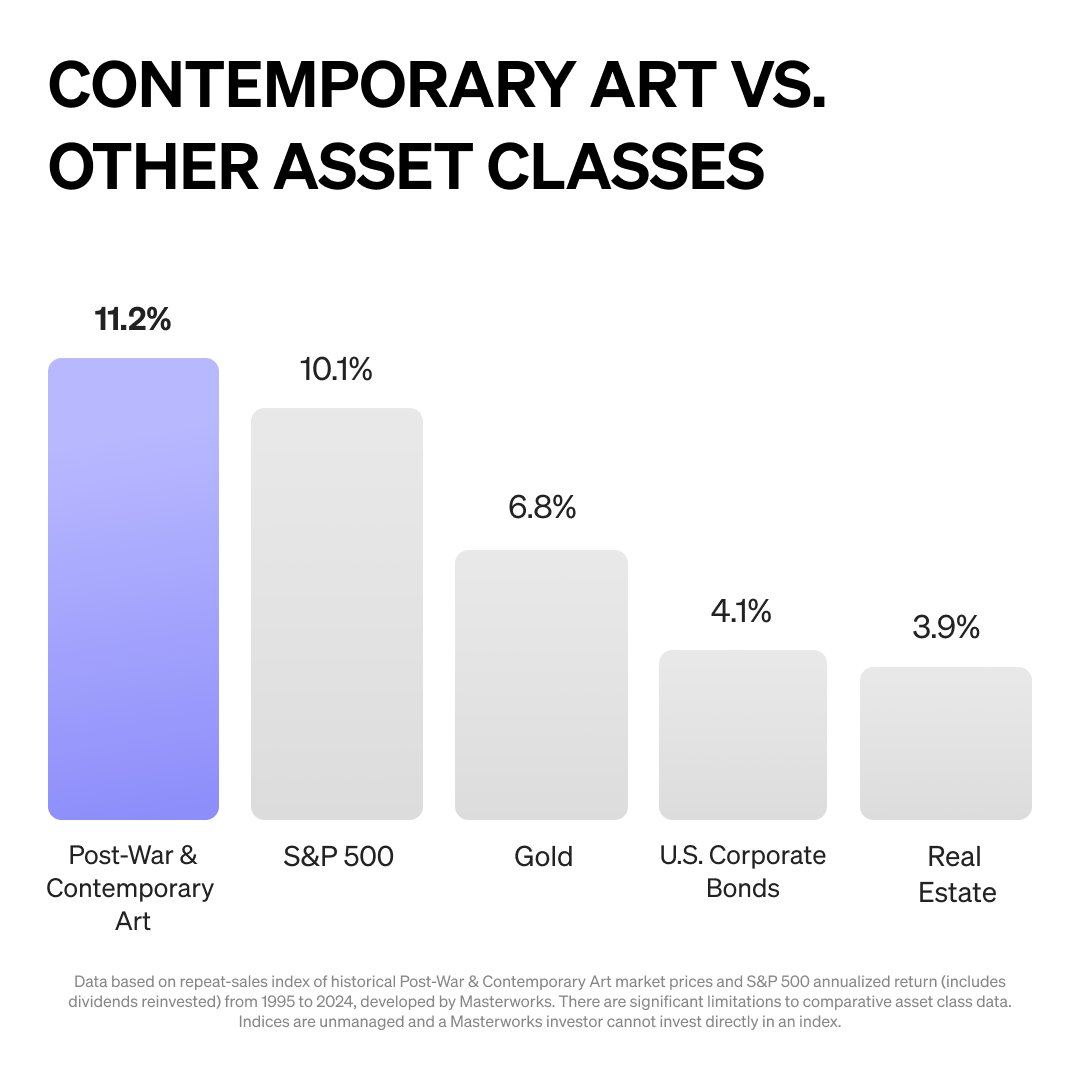
Source: Masterworks
Art has also historically served as a powerful inflation hedge — gaining 13.5% on average during periods of elevated inflation, compared to 5.5% for equities.
Masterworks' research team uses proprietary data to identify the artists and works with the most price momentum. Fewer than 3% of analyzed pieces make the cut. After acquisition, each work is securitized with the SEC, allowing investors to buy fractional shares.
To date, Masterworks has sold 28 paintings, all of which have been profitable, with representative annualized net returns of 17.6%, 17.8%, and 21.5% on works held longer than one year.
Investors can hold until the artwork sells (typically 3-10 years) or trade shares on a secondary marketplace.
If you're serious about art as an investment vehicle, Masterworks is the obvious choice.
Primary benefit: Specialization in fine art investing.
Disclosure: This is an affiliate link. We may receive compensation if you take action through it.
7. AcreTrader: best for farmland
- Our rating:
- Asset(s): Farmland
- Accreditation requirement: Accredited only
AcreTrader offers another type of real estate to invest in — farmland.
We will always need food, regardless of inflation, economic conditions, or the stock market. Couple that with a rapidly growing global population, and farmland looks like a pretty compelling investment.
Historically, its return/volatility ratio has been exceptional.
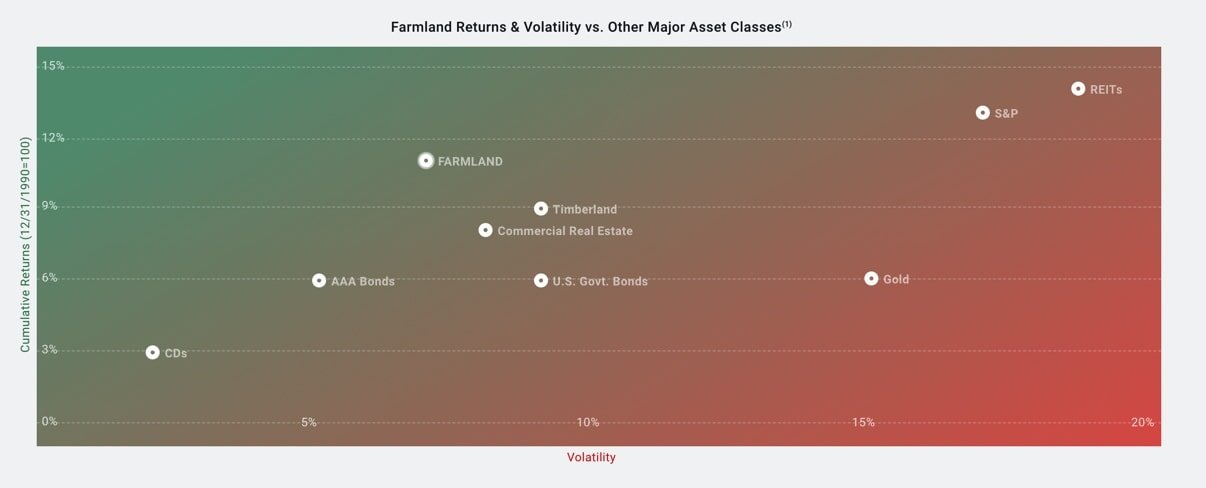
Source: AcreTrader
AcreTrader connects investors with farmers — timber, alfalfa, soybeans, corn, and more. Each new listing must pass a thorough due diligence process by AcreTrader's team of expert analysts, which only approves ~5% of deals.
The target holding periods range from 5–10 years. During that period, the farmers pay rent to AcreTrader, which distributes it among the investors. At the time of the sale, any price appreciation, pro rata rent, and principal are returned to investors.
The median realized IRR has been around 15%.
Primary benefit: The only platform where you can invest in shares of farmland.
What's the most popular private market investing platform?
This is a hard question to answer because not every platform releases this data to the public, and some information may be outdated.
Here are a few of the most popular from what data is available:
- Fundrise manages over $2.87 billion on behalf of 385,000+ investors.
- Willow Wealth has 500,000+ investors who have invested more than $6 billion on the platform.
- Masterworks has 1+ million investors and over $1 billion invested.
The most popular alternative investment is real estate. The U.S. real estate market alone is estimated to be worth close to $4 trillion. Of the platforms on this list, the best options for investing in real estate are Fundrise and EquityMultiple.
How we chose the best alternative platforms
When evaluating investing products and services, we consider the following.
- Core offering: How good is the product or service?
- Price/fees: Overall price, value for money, average cost per month, and any hidden fees.
- Usability: What the interface looks like, whether the site is easy to use and navigate, the inclusion of modern design elements and features, and accessibility.
- Credibility: Quality of information and data, as well as company and brand reputation.
- Audience: Who the product is for, the range of uses and applications, whether it actually works for its target audience, if it's the best option available, and any limitations therein.
- Offers: Whether there is a special offer for signing up or any discounts.
Final verdict
The data is pretty clear: alternatives have historically provided excellent diversification outside of public markets and have the potential for outperformance.
At this point, you may be ready to follow BlackRock's lead and invest up to 20% of your portfolio into one or more of the investment platforms listed above.
Where to allocate that 20% (or however much you decide) is up to you, based on your own goals and investing style. Each of the assets and platforms on this list has its own benefits.
My favorites from this list are:
- Fundrise, because it gives retail investors access to real estate investments, a venture capital fund, and private credit offerings with exceptionally low minimum investments.
- Percent, because it gives accredited investors access to the extremely popular private credit market. Double-digit yields, maturity dates of less than 1 year, and low default rates — what's not to like?
- Hiive and Forge, because they allow accredited investors to buy shares in many of the world's most disruptive companies.
Remember, past performance does not guarantee future results. Always do your own research before investing.
Any views expressed here do not necessarily reflect the views of Hiive Markets Limited (“Hiive”) or any of its affiliates. Stock Analysis is not a broker dealer or investment adviser. This communication is for informational purposes only, and is not a recommendation, solicitation, or research report relating to any investment strategy, security, or digital asset. All investment involves risk, including the loss of principal and past performance does not guarantee future results. There is no guarantee that any statements or opinions provided herein will prove to be correct. Stock Analysis may be compensated for user activity resulting from readers clicking on Hiive affiliate links. Hiive is a registered broker-dealer and member of FINRA / SIPC. Find Hiive on BrokerCheck.

.png)